
- News
- City News
- chennai News
- Thoothukudi Thamodharam Sankaradas: King of drama, accidental Swami
Trending
This story is from December 21, 2022
Thoothukudi Thamodharam Sankaradas: King of drama, accidental Swami
He was not a ‘Swamigal’ in the traditional sense of one who had been ritually ordained into the ascetic life. On the contrary, it was a twist of fate and a bout of vexation that turned him into one.
He was not a ‘Swamigal’ in the traditional sense of one who had been ritually ordained into the ascetic life. On the contrary, it was a twist of fate and a bout of vexation that turned him into one.
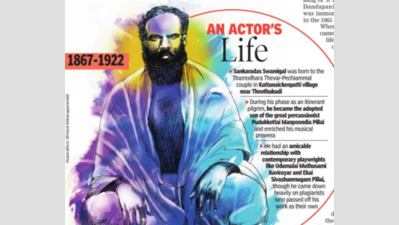
We begin the story 155 years ago, when Thoothukudi Thamodharam Sankaradas was born to a Thamodhara Thevar-Pechiammal couple in Kattunaickenpatti village near Thoothukudi.

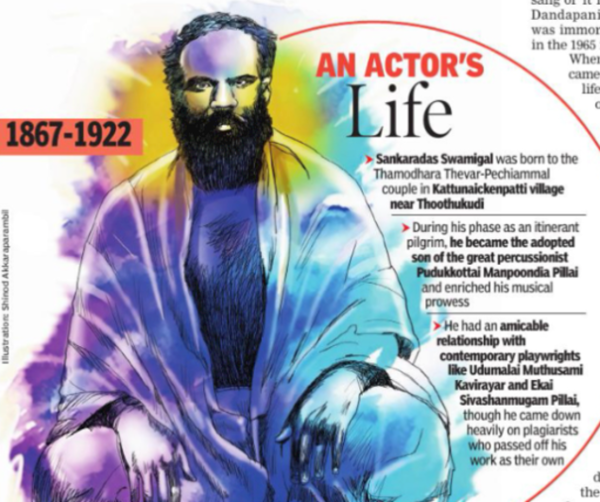
Sankaradas went on to work the accounts at the British government’s salt godown in Tuticorin. But within a short while, the mundaneness of the job got to him. With all the traditional learning that he had earned through years of Tamil study, he couldn’t wait to explore the traditional three-fold Tamil division of iyal (letters), isai (music) and naadagam (drama). The impetus was so overwhelming — especially after having seen and heard the musicals by Parsi theatrical companies — that he threw away his life of security for the chimerical world of drama.
Sankaradas first joined the drama company of veteran theatre artists Ramudu Iyer and Kalyanarama Iyer as an actor. Pammal Sambanda Mudaliar, Swamigal’s contemporary and rival claimant for the title of ‘father of renascent Tamil theatre’, albeit in the sphere of amateur theatre groups, described him as having, “a majestic bearing and commanding countenance and voice”. Sambanda Mudaliar also praised him saying he “attained great fame in playing antagonistic roles like
Yamadharma, Hiranyakashipu, Ravana and Lord Saneeswara in the Koothu plays of the day”.
A list of actors instructed by Sankaradas would read like a who’s who of Tamil stage history, but he soon got tired of the vagaries and dissolute ways of established actors and began to focus on ‘boys companies’ (as troupes featuring young boys were known in those days). The singing phenomenon of the Tamil stage S G Kittappa won his spurs as a child actor under his watchful eye. T P Rajalakshmi, who shone as a stage actor, before becoming the ‘Cinema Rani’ of the Tamil talkies, was inducted asa child artiste by Swamigal.
Sankaradas’s last offering to the Tamil stage was T K Shanmugam, whom he introduced to the world as a boy of six. Shanmugam, who was later lauded as ‘Avvai’ for his inimitable portrayal of Avvaiyar on stage and became one of the most regarded Tamil thespians, did more than anyone else in keeping Sankaradas’s memory alive.
Shanmugam quotes his father Kannusami Pillai, a co-worker in the actor’s troupe, on how realistic Sankaradas was in his roles. He speaks of an incident when Sankaradas went to a nearby well to remove his make-up as the fierce Hindu God Saneeswara, a woman who was returning after she had drawn water from the well, died of shock upon seeing him.
Soon, Sankaradas settled down to writing plays. But didn’t stop with just writing the script. He wrote the songs (sometimes set to popular tunes and sometimes to his own airs), penned the dialogues, taught them to actors, and wrote the publicity material. He went on to mentor numerous stage troupes and formed a few himself.
His dialogues, while being apt to character and scene, reflected his wide knowledge and balanced thinking. His songs not only suited every situation but also encapsulated the essence of Carnatic ragas with uncanny skill. Says musicologist B M Sundaram, ‘‘He had the rare skill of composing tunes which brought out the essence of a raga in just a line of a song. For example, his ‘Nichayamaay Theerka Kadan’ brims with Dhanyasi while Singaari Oyyaari exudes Thodi. ’’
His devotion to his chosen deity, Muruga, was a central fact of his life and he sang of it in purple verse in the Palani Dandapani Pathigam, a part of which was immortalised by K B Sundarambal in the 1965 iconic film ‘Tiruvilaiyaadal’.
When he was in his early 30s, he became vexed with the drama of stage life and its actors and stormed off on a pilgrimage. This self-imposed exile from theatre coupled with the bachelorhood that he maintained all through the 30-odd years of his remarkable life in the theatre, marked him out as a revered ‘Swamigal’ who kept the flag of Tamil song flying at a time when Telugu ruled the kutcheri podium and the elite were infatuated with English.
Poets of Swamigal’s time tended to add their mudra (name) to their songs, but he refrained from doing so. He also refused to sing in praise of human subjects.
Apart from insisting upon discipline and clean habits in the theatrical arena, Sankaradas Swamigal was a prolific playwright with more than 50 musical plays to his credit, and some of the more popular ones formed the basic template for the staging of musical theatre by professional actors down the decades.
His repertoire was mostly puranic and folklore but he even had adaptations of Shakespeare and Christian subjects like Gnana Soundari. Much of the time he based himself on the ballads easily available to common people in the evening bazaars, rather than on classical texts. His aim was the inculcation of ethical values in artistes.
Swamigal died a hundred years ago in Puducherry, then part of French India. His resting place in Karuvadikkuppam, Puducherry, is maintained by the government. Traditional drama artistes venerate him as their patron saint.
End of Article
FOLLOW US ON SOCIAL MEDIA










Photostories

Hot Picks
TOP TRENDING
Popular Categories
Hot on the Web
Top Trends
Hurricane MiltonRatan Tata NewsNew UPI Transaction LimitRatan Tata DiesPM ModiShantanu NaiduTom BradyStock Market TodayNarayana MurthyNitish Kumar ReddyIsrael Hezbollah WarRahat Tata Inspiring QuotesManagement Colleges of IndiaTop Medical Colleges of IndiaTop Engineering Colleges of IndiaTop Pharmacy Colleges of IndiaLive Cricket Score
Trending Topics
Diwali WishesBigg Boss Tamil 8 Contestants ListBhool Bhulaiyaa 3 TrailerVettaiyan Twitter ReviewSanjay Leela BhansaliVettaiyan ReviewSalman KhanDevara CollectionBigg Boss 18Deepika PadukoneShraddha KapoorRatan Tata Passed AwayColdplayVettaiyan Movie ReviewSwatantrya Veer SavarkarDussehra 2024Watch NFL Live StreamDress To ImpressRatan Tata DeathWordle Answer
Living and entertainment
Latest News
Ratan Naval Tata: The inspiring journey of Padma Vibhushan laureate and golden-hearted business tycoonHow Chennai Night Race swerved past challenges to zoom toward a brighter motorsports futureAll-Star Tower Defense (ASTD) Codes October 2024Samantha Ruth Prabhu shares playtime with Chinmayi Sripaada's daughter, says 'It took her 4.5 seconds to disown her parents'Mohanlal remembers late TP Madhavan: ‘His love and affection were akin to that of a father towards me'Who is Noel Tata? Meet Ratan Tata’s half-brother, who could be successor at Tata TrustsHow to make Ginger Turmeric Shots for seasonal changeWhen Amitabh Bachchan slept on Marine Drive with rats as neighbours: I didn’t have a place to stayManifesting with the 10/10 Portal: Zodiac-based guide for 2024Hanging Lights For Living Room: Transform and Illuminate Your SpaceICC Women's T20 World Cup: Harmanpreet Kaur, Smriti Mandhana, bowlers demolish Sri Lanka as India get NRR boostOnly a true creative genius can spot the odd unicorn in 12 seconds!Ratan Tata no more: When his throwback pic had netizens saying he looked like a Hollywood star'Vettaiyan' Twitter review: Rajinikanth shines in this investigative thrillerCan simple lifestyle changes really keep the flu at bay?'Vettaiyan' early and first review: Rajinikanth starrer has a good twist!CATS YouTube codes for October 10, 2024: Enhance your gameplay and know how to redeem the codesBigg Boss 18: Karan Veer Mehra opens up about losing his father at the age of 10; says 'Main apne dad ki death par nahi roya'
Copyright © 2024 Bennett, Coleman & Co. Ltd. All rights reserved. For reprint rights: Times Syndication Service